Shared Libraries
Traditional creation of programs
- This is also called static linking
- The old way of creating programs was by writing multiple
source files
(text files with program code), then translating each one (called
compile
), thus creating
object files
.
The, link these files to create an executable file, that can be run: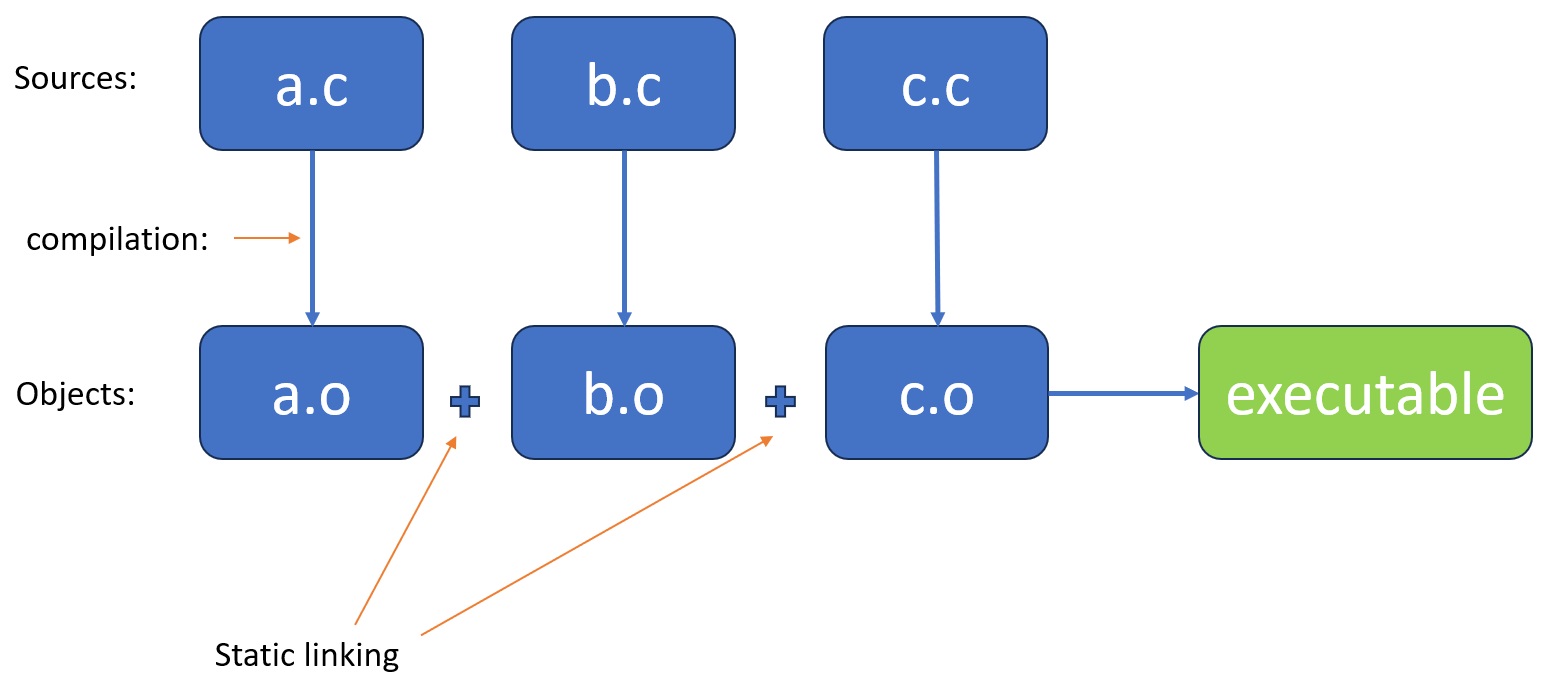
Dynamic Libraries
- You could have part of the code linked into your program when it is running (so after compilation and static linking).
- Options are:
- Link just before you program starts to run
- Link when your decides it needs the code
- You could see that an executable tries to link a shared library by using the ldd (list dynamic depeldencies) command:
1$ ldd /usr/bin/ls
2	linux-vdso.so.1 (0x00007ffe51f33000)
3	libselinux.so.1 => /lib/x86_64-linux-gnu/libselinux.so.1 (0x00007f66cf2e7000)
4	libc.so.6 => /lib/x86_64-linux-gnu/libc.so.6 (0x00007f66cf000000)
5	libpcre2-8.so.0 => /lib/x86_64-linux-gnu/libpcre2-8.so.0 (0x00007f66cf24d000)
6	/lib64/ld-linux-x86-64.so.2 (0x00007f66cf34b000)
7$
(remember that the ls command is actually an executable file)
- The libc.so.6 file from the last example is actually the C standard library , that includes many well-known C functions (printf, open, fopen, strcpy, strcat..etc)
How Dynamic Libraries save Memory and Dick Space
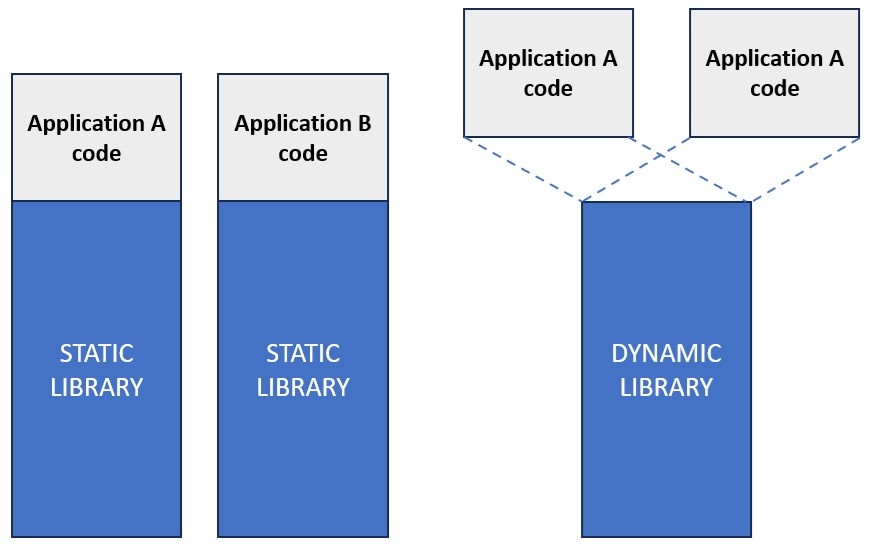
- When you use a static library, it is saved to disk with each program you create
- When you run a program that was statically linked, the static code is loaded into memory for each copy of the program.
- Think of the C standard library for example:
- it would be loaded for almost each running process
- multiple copies of the same program will copy it into RAM (and disk)
- different programs will copy it (RAM and disk)
- With a dynamic linking, a single copy os the standard library exists on disk, and a single copy in memory, and all running processes can share (link into) this copy.
- While we're not going into the details that make this possible, you can read about
virtual memory
to see how this is done under the hood.