langgraph reference
Pinned version: langgraph==1.2.11 (released 2026-08-11; it pulls in langgraph-checkpoint
4.2.0, langgraph-prebuilt 1.1.0 and langgraph-sdk 0.4.4; the SqliteSaver example also needs
langgraph-checkpoint-sqlite==3.1.1). Everything below was derived by
inspecting this exact installed package, and every example was executed against it on Python 3.13.
Each heading links to reference.langchain.com,
which is unversioned and always serves the latest 1.x. Links open in a new tab.
Part of a five-page set — see
how the LangChain stack fits together for how langchain-core,
langgraph and langchain fit together.
What langgraph is
langgraph is a runtime that executes a graph of Python functions over a shared, typed state. You
declare the state as a TypedDict, register functions as nodes and wire them with edges; the
runtime decides the execution order, runs independent nodes in parallel, merges each node's returned
dict into the state (through a reducer per key, or by overwriting), and can save the state after
every step, so a run can pause, resume or be replayed.
- It works at the level where agent architecture is expressed — the loop, the branches and the pause points are yours to place. That is what "low level" means here.
- It is model-agnostic. The runtime does not care what a node does. Every example below is a
plain Python function that imports nothing but
langgraphand stdlibtyping. langchainis built on it, and not the reverse.langchain.agents.create_agentreturns aCompiledStateGraph, soinvoke,stream, checkpointing andinterrupton an agent behave exactly as documented below.
Layer order
1langchain ──depends on──▶ langgraph ──depends on──▶ langchain-core
Nothing below depends on anything above it. Verified against the installed packages:
langchain_coredoes not importlanggraph. After importing every module oflangchain-core1.6.2,'langgraph' in sys.modulesisFalse.langgraphdoes not importlangchain.langchainis absent from itsRequires-Dist, and importinglanggraph.graph,langgraph.types,langgraph.checkpoint.memoryandlanggraph.prebuiltleaves'langchain' in sys.modulesFalse. Two optional code paths try it lazily insidetry:/except ImportError:(init_chat_modelfor"provider:model"strings in the deprecatedcreate_react_agent, andinit_embeddingsin the store) and fail soft without it.langgraphdoes depend onlangchain-core(<2,>=1.4.7) — that is how a node can return message objects the rest of the ecosystem understands, and howMessagesStateconverts dicts intoHumanMessage/AIMessage.
Every example in this file was executed in a venv where langchain is installed but never
imported (checked via sys.modules).
create_react_agenthas moved:langgraph.prebuilt.create_react_agentstill imports, but calling it emitsLangGraphDeprecatedSinceV10: "create_react_agent has been moved tolangchain.agents. Please update your import tofrom langchain.agents import create_agent. Deprecated in LangGraph V1.0 to be removed in V2.0." The other prebuilt pieces (ToolNode,tools_condition,InjectedState,ToolRuntime) remain, andcreate_agentuses them internally.
Index
One group per module, in the order the sections below appear.
| Module | Name | What it defines / does | Most-used methods & fields |
|---|---|---|---|
langgraphgraph | StateGraph | Builder: takes the state TypedDict; add_node registers a function, add_edge/add_conditional_edges wire them, compile() returns the runnable graph | add_node, add_edge, add_conditional_edges, compile |
START and END | The strings "__start__" and "__end__"; an edge from START names the entry node, an edge to END ends the run | used as edge endpoints | |
CompiledStateGraph | The runnable compile() returns: invoke/stream execute it, get_state/update_state read and edit a thread's checkpoint, get_graph draws it | invoke, stream, get_state, update_state, get_graph | |
MessagesState | TypedDict with one key, messages: Annotated[list[AnyMessage], add_messages] — a conversation that grows by appending | messages | |
add_messages | Reducer (old, new) -> merged: appends new messages, replaces those whose id already exists, deletes on RemoveMessage, coerces dicts to message objects | called as add_messages(left, right) | |
langgraphtypes | Command | Node return value carrying update= (state changes) and goto= (next node) together; Command(resume=…) is also how a paused run is resumed | goto, update, resume, graph |
interrupt | Called inside a node: saves a checkpoint, stops the run, surfaces value under __interrupt__; on resume the node re-runs and the call returns the resume payload | called as interrupt(value) | |
Send | Send(node, arg) returned from a conditional edge schedules one run of node with arg as its input; a list of them fans out in parallel | node, arg | |
langgraphcheckpoint.* | InMemorySaver | Dict-backed BaseCheckpointSaver: compile(checkpointer=…) then saves state after every step, keyed by thread_id, enabling resume, interrupt, history and time travel | get_tuple, put, list, delete_thread |
SqliteSaver | The same BaseCheckpointSaver contract as InMemorySaver, stored in a SQLite file: a paused thread survives the process, and a fresh connection resumes it | from_conn_string, get_tuple, put, list, delete_thread |
One more module shows up without an entry of its own: langgraph.prebuilt, the ready-made agent
parts (ToolNode, tools_condition, InjectedState, ToolRuntime) that langchain's
create_agent wires together for you.
langgraph.graph
The pieces you build a graph out of. StateGraph collects the nodes and edges and compile() turns them into something runnable; START and END mark where a run enters and leaves. The module also ships the ready-made state for the commonest case, a conversation: MessagesState, whose single messages key grows by appending because the reducer add_messages is attached to it.
StateGraph
The builder. StateGraph(State) takes the state schema — a TypedDict whose keys are the state
and whose Annotated[..., reducer] metadata says how a key is merged (no reducer = overwrite).
Optional input_schema=/output_schema= narrow what callers pass in and get back, and
context_schema= types the read-only runtime.context nodes can receive. Then:
add_node(name, fn)registers a functionfn(state) -> dict(or-> Command). The function receives the whole state and returns only the keys it changes. Options:retry_policy,cache_policy,defer=True(run after all other branches finish),destinations(declares where aCommand-returning node maygoto, for drawing).add_edge(a, b)always runsbaftera.add_edge([a, b], c)waits for both.add_conditional_edges(source, router, path_map)runsrouter(state)aftersource; its return value is looked up inpath_map(a dict) or used as a node name directly (a list).add_sequence([f, g, h])adds nodes and the edges between them in one call.compile(checkpointer=, store=, interrupt_before=, interrupt_after=, name=, cache=)validates the graph (every node reachable, every edge target exists) and returns aCompiledStateGraph.
 1from typing import TypedDict
 2
 3from langgraph.graph import END, START, StateGraph
 4
 5
 6class State(TypedDict):
 7    n: int
 8    label: str
 9
10
11def double(state: State) -> dict:
12    return {"n": state["n"] * 2}
13
14
15def classify(state: State) -> str:
16    return "even" if state["n"] % 2 == 0 else "odd"
17
18
19def mark_even(state: State) -> dict:
20    return {"label": "even"}
21
22
23def mark_odd(state: State) -> dict:
24    return {"label": "odd"}
25
26
27builder = StateGraph(State)
28builder.add_node("double", double)
29builder.add_node("mark_even", mark_even)
30builder.add_node("mark_odd", mark_odd)
31builder.add_edge(START, "double")
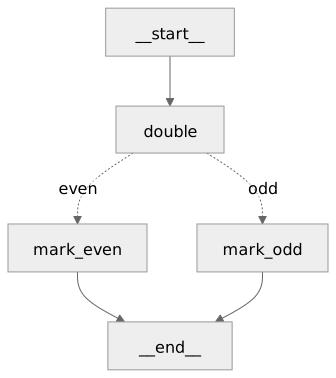
32builder.add_conditional_edges("double", classify, {"even": "mark_even", "odd": "mark_odd"})
33builder.add_edge("mark_even", END)
34builder.add_edge("mark_odd", END)
35
36graph = builder.compile()
37print(graph.invoke({"n": 5, "label": ""}))   # {'n': 10, 'label': 'even'}
38print(graph.get_graph().draw_mermaid(with_styles=False))
Diagram — generated by the code above:
START and END
Two virtual nodes that mark where execution enters and leaves the graph. They are not classes —
they are the strings '__start__' and '__end__', which is exactly why they can be passed anywhere
a node name is expected. add_edge(START, "x") makes x the entry point (the older
set_entry_point("x") does the same); an edge or Command(goto=END) into END finishes the run.
A graph may have several edges into END, and a node with no outgoing edge at all is a build
error.
1from langgraph.graph import END, START
2
3print(repr(START), repr(END))   # '__start__' '__end__'
4print(isinstance(START, str))   # True
CompiledStateGraph
What .compile() hands back, and the only thing you actually run. It is a Runnable, so
invoke, batch, stream and their async twins work as on any other. On top of that it adds:
- Streaming modes.
stream(input, stream_mode=…):"updates"(default) yields{node_name: returned_dict}as each node finishes;"values"yields the full state after each step;"messages"yields model tokens as they arrive;"custom"yields what nodes write viaget_stream_writer();"debug"yields everything. - The state API, all taking
config={"configurable": {"thread_id": …}}and requiring a checkpointer:get_state(config)returns aStateSnapshot(.values,.next— the nodes about to run —.tasks,.config);get_state_history(config)iterates snapshots newest-first;update_state(config, values, as_node=…)writes a new checkpoint as if a node had returnedvalues. - Introspection.
get_graph()returns a drawable graph object (draw_mermaid(),draw_mermaid_png(),draw_ascii());get_subgraphs()lists nested compiled graphs.
 1from typing import TypedDict
 2
 3from langgraph.graph import END, START, StateGraph
 4
 5
 6class State(TypedDict):
 7    n: int
 8
 9
10def double(state: State) -> dict:
11    return {"n": state["n"] * 2}
12
13
14def bump(state: State) -> dict:
15    return {"n": state["n"] + 1}
16
17
18builder = StateGraph(State)
19builder.add_node("double", double)
20builder.add_node("bump", bump)
21builder.add_edge(START, "double")
22builder.add_edge("double", "bump")
23builder.add_edge("bump", END)
24graph = builder.compile()
25
26print(type(graph).__name__)           # CompiledStateGraph
27print(graph.invoke({"n": 3}))         # {'n': 7}
28for chunk in graph.stream({"n": 3}):                        # default stream_mode="updates"
29    print(chunk)                      # {'double': {'n': 6}} then {'bump': {'n': 7}}
30for snapshot in graph.stream({"n": 3}, stream_mode="values"):
31    print(snapshot)                   # {'n': 3} then {'n': 6} then {'n': 7}
32print(graph.get_graph().draw_mermaid(with_styles=False))
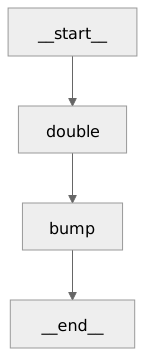
Diagram — generated by the code above:
MessagesState
A ready-made state schema for the common case of "the state is a conversation". It is a TypedDict
with a single key, messages: Annotated[list[AnyMessage], add_messages], so nodes return the new
messages only and the runtime appends them. Because the reducer is
add_messages,
message-like dicts ({"role": "user", "content": ...}) are converted to HumanMessage/AIMessage
objects on the way in — no model or langchain import needed. Subclass it to add keys:
class State(MessagesState): summary: str. langchain.agents.AgentState is such a subclass.
 1from langgraph.graph import END, MessagesState, START, StateGraph
 2
 3
 4def greet(state: MessagesState) -> dict:
 5    return {"messages": [{"role": "assistant", "content": "Hello!"}]}
 6
 7
 8builder = StateGraph(MessagesState)
 9builder.add_node("greet", greet)
10builder.add_edge(START, "greet")
11builder.add_edge("greet", END)
12graph = builder.compile()
13
14result = graph.invoke({"messages": [{"role": "user", "content": "Hi"}]})
15for m in result["messages"]:
16    print(type(m).__name__, "|", m.content)
17# HumanMessage | Hi
18# AIMessage | Hello!
19print(graph.get_graph().draw_mermaid(with_styles=False))
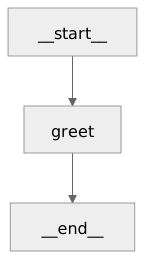
Diagram — generated by the code above:
add_messages
The reducer behind MessagesState. A reducer is a function (old, new) -> merged attached to a
state key via Annotated; without one, a node's return value overwrites the key. What this one
does with the incoming list, item by item:
- coerces a dict or
(role, text)tuple into the matching message class, and assigns a randomidto any message that has none; - appends a message whose
idis new; - replaces in place a message whose
idalready exists in the old list — that is how history is edited rather than duplicated; - deletes the message named by a
RemoveMessage(id=…), and clears the whole list onRemoveMessage(id=REMOVE_ALL_MESSAGES).
 1from langchain_core.messages import RemoveMessage
 2from langgraph.graph import add_messages
 3from langgraph.graph.message import REMOVE_ALL_MESSAGES
 4
 5history = add_messages(
 6    [{"role": "user", "content": "Hi", "id": "1"}],
 7    [{"role": "assistant", "content": "Hello!", "id": "2"}],
 8)
 9print([(type(m).__name__, m.content) for m in history])
10# [('HumanMessage', 'Hi'), ('AIMessage', 'Hello!')]
11
12edited = add_messages(history, [{"role": "user", "content": "Hey", "id": "1"}])
13print([(type(m).__name__, m.content) for m in edited])
14# [('HumanMessage', 'Hey'), ('AIMessage', 'Hello!')]
15
16shorter = add_messages(edited, [RemoveMessage(id="2")])
17print([m.content for m in shorter])                                  # ['Hey']
18
19print(add_messages(edited, [RemoveMessage(id=REMOVE_ALL_MESSAGES)]))  # []
langgraph.types
The values that steer the run itself, rather than merely updating state. A node returns a Command to change the state and name the next node in one object, calls interrupt to stop mid-node until a caller resumes the thread, and a router returns Send objects to start one parallel copy of a node per item when the count is known only at runtime.
Command
A dataclass a node can return instead of a plain dict. Its fields, all optional:
update— the state changes (same shape as a returned dict).goto— the next node name, a list of names (run in parallel), aSend, orEND. This replaces a separate routing function when the node already knows where to go.graph—Command.PARENTmakesgototarget a node of the parent graph when the node lives inside a subgraph.resume— used from outside, as the input toinvoke, to continue a run paused byinterrupt; its value is what theinterrupt()call returns.
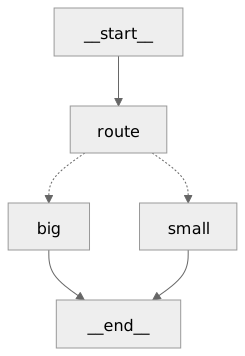
Annotating the return type as Command[Literal["big", "small"]] (or passing destinations= to
add_node) is what lets get_graph() draw the possible jumps — without it the diagram shows no
edges out of the node, though execution is unaffected.
 1from typing import Literal, TypedDict
 2
 3from langgraph.graph import END, START, StateGraph
 4from langgraph.types import Command
 5
 6
 7class State(TypedDict):
 8    n: int
 9    path: str
10
11
12def route(state: State) -> Command[Literal["big", "small"]]:
13    if state["n"] > 10:
14        return Command(goto="big", update={"path": "big"})
15    return Command(goto="small", update={"path": "small"})
16
17
18def big(state: State) -> dict:
19    return {"n": state["n"] + 100}
20
21
22def small(state: State) -> dict:
23    return {"n": state["n"] + 1}
24
25
26builder = StateGraph(State)
27builder.add_node("route", route)
28builder.add_node("big", big)
29builder.add_node("small", small)
30builder.add_edge(START, "route")
31builder.add_edge("big", END)
32builder.add_edge("small", END)
33graph = builder.compile()
34
35print(graph.invoke({"n": 42, "path": ""}))   # {'n': 142, 'path': 'big'}
36print(graph.get_graph().draw_mermaid(with_styles=False))
Diagram — generated by the code above:
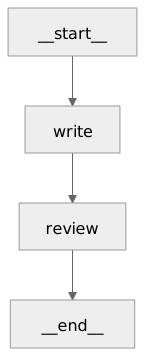
interrupt
A function called inside a node: interrupt(value). What happens, in order:
- The runtime writes a checkpoint (so a
checkpointeris required — without one it raises) and stops the run.invokereturns the state so far plus an__interrupt__key holding a list ofInterruptobjects, each with.value(what you passed) and.id. - The caller does whatever the pause is for — shows the value to a person, waits a week.
- The caller invokes the same thread with
Command(resume=payload). The interrupted node runs again from its first line; this timeinterrupt()does not pause but returnspayload, and the node continues to its return.
The re-run in step 3 is the detail that bites: code before the interrupt() call executes twice,
so keep side effects after it or make them idempotent. The example counts the node's runs to show
this.
 1from typing import TypedDict
 2
 3from langgraph.checkpoint.memory import InMemorySaver
 4from langgraph.graph import END, START, StateGraph
 5from langgraph.types import Command, interrupt
 6
 7runs = {"review": 0}
 8
 9
10class State(TypedDict):
11    draft: str
12    approved: str
13
14
15def write(state: State) -> dict:
16    return {"draft": "ship it"}
17
18
19def review(state: State) -> dict:
20    runs["review"] += 1                                     # executes on both passes
21    decision = interrupt({"question": "Approve this draft?", "draft": state["draft"]})
22    return {"approved": decision}
23
24
25builder = StateGraph(State)
26builder.add_node("write", write)
27builder.add_node("review", review)
28builder.add_edge(START, "write")
29builder.add_edge("write", "review")
30builder.add_edge("review", END)
31graph = builder.compile(checkpointer=InMemorySaver())
32
33config = {"configurable": {"thread_id": "1"}}
34paused = graph.invoke({"draft": "", "approved": ""}, config)
35print(paused["__interrupt__"][0].value)
36# {'question': 'Approve this draft?', 'draft': 'ship it'}
37print(graph.get_state(config).next)                        # ('review',)  <- where it will resume
38
39resumed = graph.invoke(Command(resume="yes"), config)
40print(resumed)                                             # {'draft': 'ship it', 'approved': 'yes'}
41print("review ran", runs["review"], "times")               # review ran 2 times
42print(graph.get_graph().draw_mermaid(with_styles=False))
Diagram — generated by the code above:
Send
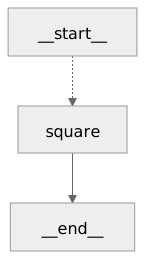
Send(node, arg) is an instruction to run node once with arg as its input instead of the
shared state. Return a list of them from a conditional-edge router (or as Command(goto=[...]))
and the runtime schedules one task per Send, all in the same step and in parallel; each task's
returned dict is merged back into the shared state through the key's reducer. That is the map half
of map-reduce, and the way to branch N ways when N is only known at runtime. The receiving node's
parameter is whatever you passed as arg, so type it accordingly, not as the graph's State.
 1from typing import Annotated, TypedDict
 2
 3from langgraph.graph import END, START, StateGraph
 4from langgraph.types import Send
 5
 6
 7class State(TypedDict):
 8    items: list
 9    results: Annotated[list, lambda a, b: a + b]
10
11
12def fan_out(state: State):
13    return [Send("square", {"value": i}) for i in state["items"]]
14
15
16def square(state: dict) -> dict:           # receives {"value": i}, not the State
17    return {"results": [state["value"] ** 2]}
18
19
20builder = StateGraph(State)
21builder.add_node("square", square)
22builder.add_conditional_edges(START, fan_out, ["square"])
23builder.add_edge("square", END)
24graph = builder.compile()
25
26print(graph.invoke({"items": [1, 2, 3], "results": []}))
27# {'items': [1, 2, 3], 'results': [1, 4, 9]}
28print(graph.get_graph().draw_mermaid(with_styles=False))
Diagram — generated by the code above:
langgraph.checkpoint.*
Where a run's state is kept between steps, and so between calls. langgraph.checkpoint.base defines the interface, BaseCheckpointSaver; .memory implements it in a dict and .sqlite in a file (from the separate langgraph-checkpoint-sqlite package), with Postgres a third package away. Passing one to compile(checkpointer=…) is the single change that buys memory across invocations, interrupt, history and time travel — a graph compiled without one forgets everything the moment invoke returns.
InMemorySaver
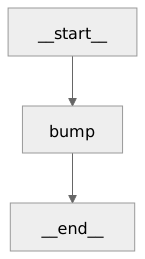
A checkpointer: pass one to compile(checkpointer=…) and the graph writes a snapshot of the state
after every step, filed under the thread_id in config["configurable"]. That single change is
what turns a one-shot graph into a resumable, inspectable conversation:
- Continuation. Invoking the same
thread_idagain starts from the saved state and merges the new input into it through the reducers, so aMessagesStategraph remembers earlier turns (a key without a reducer, likecountbelow, is simply overwritten by the new input). - Pausing.
interruptandinterrupt_before/interrupt_afterneed somewhere to park the run. - History and time travel.
get_state_history(config)returns every checkpoint; invoking with one of those checkpoints'configreplays from that point.
It implements
BaseCheckpointSaver,
the interface every backend satisfies: put (store a checkpoint), put_writes (store a node's
pending writes), get_tuple (load the latest, or a specific one), list (iterate a thread's
checkpoints), delete_thread, and async twins. InMemorySaver keeps all of it in a dict, so it is
for development and tests; langgraph-checkpoint-sqlite and langgraph-checkpoint-postgres are
the production swaps and change nothing else in your code.
 1from typing import TypedDict
 2
 3from langgraph.checkpoint.base import BaseCheckpointSaver
 4from langgraph.checkpoint.memory import InMemorySaver
 5from langgraph.graph import END, START, StateGraph
 6
 7
 8class State(TypedDict):
 9    count: int
10
11
12def bump(state: State) -> dict:
13    return {"count": state["count"] + 1}
14
15
16builder = StateGraph(State)
17builder.add_node("bump", bump)
18builder.add_edge(START, "bump")
19builder.add_edge("bump", END)
20
21checkpointer = InMemorySaver()
22print(isinstance(checkpointer, BaseCheckpointSaver))   # True
23graph = builder.compile(checkpointer=checkpointer)
24
25config = {"configurable": {"thread_id": "session-1"}}
26print(graph.invoke({"count": 0}, config))     # {'count': 1}
27print(graph.get_state(config).values)         # {'count': 1}
28print(graph.get_state(config).next)           # () — the run finished
29
30for snap in graph.get_state_history(config):   # newest first: 3 checkpoints for one run
31    print(snap.metadata["step"], snap.values, snap.next)
32# 1 {'count': 1} ()            <- after bump
33# 0 {'count': 0} ('bump',)     <- input written, bump about to run
34# -1 {} ('__start__',)         <- the empty thread
35
36print(graph.invoke({"count": 10}, config))    # {'count': 11}  <- same thread, run again
37print(len(list(checkpointer.list(config))))   # 6 — the saver holds both runs
38graph.update_state(config, {"count": 100}, as_node="bump")
39print(graph.get_state(config).values)         # {'count': 100} <- written as if bump returned it
40print(graph.get_graph().draw_mermaid(with_styles=False))
Diagram — generated by the code above:
SqliteSaver
The first checkpointer that outlives the process. It comes from the separate package
langgraph-checkpoint-sqlite (import langgraph.checkpoint.sqlite) and implements exactly the
BaseCheckpointSaver interface
InMemorySaver does — put, put_writes,
get_tuple, list, delete_thread, and async twins in AsyncSqliteSaver — on top of a
sqlite3 connection. What that changes:
- The thread is a row on disk. A run paused by
interruptcan be resumed by a different process: open the same file, compile the same graph, invoke the samethread_idwithCommand(resume=…).get_state(config).nexttells you where it parked. - Construction.
SqliteSaver(conn)takes an opensqlite3.Connection;SqliteSaver.from_conn_string(path)is a context manager that opens the connection (withcheck_same_thread=False) and closes it on exit —":memory:"gives a throwaway database. Tables are created on first use (setup()does it explicitly). - What it is for. Local tools, labs, single-machine services. It serialises with the same
msgpack serde as
InMemorySaver, so the sameTypeErrorfor unserializable state applies. Multi-process concurrency is wherelanggraph-checkpoint-postgrestakes over; the code you wrote does not change.
 1import os
 2import tempfile
 3from typing import TypedDict
 4
 5from langgraph.checkpoint.base import BaseCheckpointSaver
 6from langgraph.checkpoint.sqlite import SqliteSaver
 7from langgraph.graph import END, START, StateGraph
 8from langgraph.types import Command, interrupt
 9
10
11class State(TypedDict):
12    count: int
13    ok: str
14
15
16def bump(state: State) -> dict:
17    return {"count": state["count"] + 1}
18
19
20def confirm(state: State) -> dict:
21    return {"ok": interrupt("continue?")}
22
23
24builder = StateGraph(State)
25builder.add_node("bump", bump)
26builder.add_node("confirm", confirm)
27builder.add_edge(START, "bump")
28builder.add_edge("bump", "confirm")
29builder.add_edge("confirm", END)
30
31path = os.path.join(tempfile.mkdtemp(), "checkpoints.sqlite")
32config = {"configurable": {"thread_id": "t1"}}
33
34with SqliteSaver.from_conn_string(path) as saver:            # "process 1"
35    print(isinstance(saver, BaseCheckpointSaver))            # True
36    graph = builder.compile(checkpointer=saver)
37    paused = graph.invoke({"count": 0, "ok": ""}, config)
38    print(paused["__interrupt__"][0].value)                  # continue?
39
40print(os.path.getsize(path) > 0)                             # True — the run is on disk
41
42with SqliteSaver.from_conn_string(path) as saver:            # "process 2": a fresh connection
43    graph = builder.compile(checkpointer=saver)
44    print(graph.get_state(config).next)                      # ('confirm',)  <- parked, on disk
45    print(graph.invoke(Command(resume="yes"), config))       # {'count': 1, 'ok': 'yes'}
46    print(len(list(saver.list(config))))                     # 4 — the whole thread, both halves